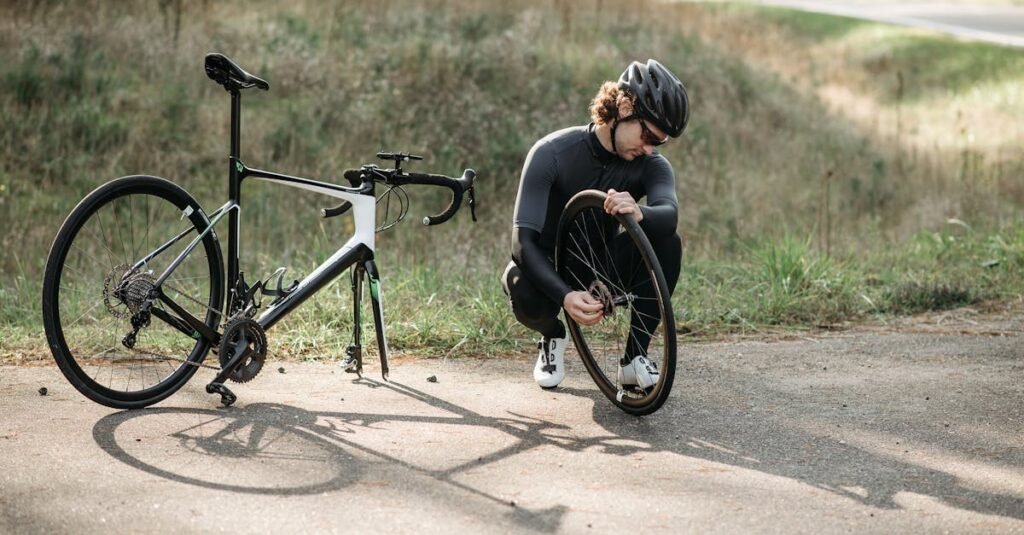
Adjusting the Rear Derailleur
Learn Road, Race And Mountain Repairs

- Work through chapters organized by the bike’s mechanical systems for easy learning
- Get a 150-page illustrated manual to reference while you work in your home setup
- Use easy-to-follow demonstrations that make daunting tasks feel manageable
The rear derailleur plays a crucial role in shifting between gears smoothly and accurately. Adjusting it may require some patience, but the result significantly enhances your biking experience. Begin by checking the limit screws. These screws control how far the derailleur can move in both directions. Adjust the high limit screw to ensure the chain can shift smoothly onto the smallest cog and the low limit screw for the largest cog. A misaligned derailleur can lead to skipping gears or the chain falling off.
Next, inspect the jockey wheels to ensure they are clean and properly aligned. This helps in minimizing friction, allowing for smoother transitions between gears. The overall alignment of the derailleur should allow the chain to run straight through the jockey wheels with no noticeable deviations. If necessary, fine-tune the derailleur’s angle and height to achieve the optimal position. This adjustment ensures that the chain moves seamlessly, enhancing both performance and longevity.
Key Steps for Rear Derailleur Fine-Tuning
Start by locating the limit screws on the rear derailleur. These screws control how far the derailleur can move towards the spokes and cassette. Shift into the highest gear, which is typically the smallest cog, and adjust the high limit screw until the chain is aligned perfectly with that cog. Shift down to the lowest gear to check the other limit. Adjust the low limit screw in a similar manner to ensure the derailleur doesn’t push the chain off the largest cog.
Next, focus on the B-screw, which controls the distance between the derailleur and the largest cog. This distance is crucial for smooth shifting. With the chain on the largest cog, turn the B-screw to adjust the angle and clearance of the derailleur. A proper setting allows the chain to shift without rubbing against the derailleur. Once both limit screws and the B-screw are adjusted, shift through all gears while observing how smoothly the transitions occur. Make additional fine adjustments as necessary to achieve seamless performance.
Cable Tension Adjustment
Achieving the right cable tension is crucial for smooth and precise gear shifts. Start by inspecting the derailleur while shifting through the gears to ensure they move appropriately without hesitation. If the shifts are sluggish or skip gears, it may indicate that the cable tension is either too loose or too tight. A simple test involves shifting into the largest chainring and the largest rear sprocket, allowing you to assess the derailleur’s positioning.
To adjust the cable tension, locate the barrel adjuster on the derailleur or shifter. Turn the barrel adjuster counterclockwise to increase tension and clockwise to decrease it. After making adjustments, check each gear again to confirm that they shift correctly under load. Repeating this process may be necessary until you find the sweet spot that offers both reliability and responsiveness in your gear changes.
How to Achieve Perfect Cable Tension
Proper cable tension is essential for smooth gear shifting. To achieve this, start by shifting into the smallest chainring and the smallest rear cog. This position creates slack in the cable, allowing for easier adjustments. Utilize the barrel adjuster on the rear derailleur to fine-tune tension. Turning the barrel adjuster clockwise generally adds tension while counterclockwise reduces it. Make small adjustments and frequently test shifts to determine the effect of each tweak.
After making adjustments, shift through the gears to check performance. If you find that shifts remain sluggish or gears fail to engage properly, reevaluate the cable tension. It may be necessary to repeat the adjustment process if issues persist. A well-tuned cable tension not only improves shifting efficiency but also enhances overall riding experience, allowing for smoother transitions between gears on various terrains.
The Ultimate At-Home Bike MasterClass
- Repair and maintain road, race, and mountain bikes with guidance tailored to each
- Keep your bike running smoothly with cleaning and lubrication best practices
- Get support through video chat or email when you need help on a tricky step
Checking Gear Alignment
Proper gear alignment is crucial for smooth shifting and overall bike performance. Misalignment can lead to skipping gears or difficulty in transitioning between them. To check alignment, begin by inspecting the derailleur hanger, ensuring it is not bent. A precise alignment with your wheel’s cassette is necessary. The gap between the derailleur and the cassette should be uniform and adjusted according to manufacturer specifications.
After confirming the derailleur hanger’s condition, shift into the highest gear and visually assess the line between the derailleur’s jockey wheel and the cassette. If they do not line up directly, this can indicate a misalignment. Small adjustments to the derailleur can help achieve the correct position. Using a tuning tool can assist in making fine adjustments to ensure the gear shifting is smooth and responsive.
Methods to Ensure Accurate Gear Alignment
Proper gear alignment is essential for smooth shifting and overall bike performance. Begin by checking the position of the derailleur relative to the cogset. Utilize a straight edge to ensure the derailleur is parallel to the cassette. Any misalignment can result in skipping gears or difficulty shifting. Adjust the derailleur hanger if necessary, as a bent hanger can lead to persistent alignment issues.
Next, assess the distance between the derailleur and the gears. It’s important that the jockey wheel aligns closely with the gears when shifting. A common method to achieve this is by shifting to the largest chainring and the largest rear cog, then observing the gap. Adjust the limit screws if the derailleur is too close or too far from the cassette. Regular checks can prevent wear and tear, ensuring a smoother riding experience.
FAQS
Why is it important to fine-tune my bicycle gears?
Fine-tuning your bicycle gears ensures smooth shifting, improves overall performance, and enhances your riding experience by reducing wear and tear on components.
What tools do I need to adjust my rear derailleur?
You typically need a Phillips screwdriver, a 5mm Allen wrench, and a cable cutter. A bike stand can also be helpful for easier access to the rear derailleur.
How do I know if my cable tension is off?
If your gears are slipping, shifting is sluggish or inconsistent, or if you hear a grinding noise when shifting, these are signs that your cable tension may need adjustment.
What should I look for when checking gear alignment?
Check that the derailleur is properly aligned with the cassette and that the chain is running straight without rubbing against the derailleur or other components.
How often should I fine-tune my bicycle gears?
It’s recommended to fine-tune your bicycle gears at least once a month or before long rides, especially if you frequently ride on varying terrains or conditions. Regular maintenance can help prevent more significant issues down the line.
Related Links
What to Expect When Tuning Your Bicycle Gears
How to Diagnose Gear Tuning Problems in Bicycles
Upgrade And Maintain Any Bicycle
- Keep your bike running smoothly with cleaning and lubrication best practices
- Benefit from three different instructors and teaching styles across three bike types
- Make bike maintenance feel practical, organized, and doable from home